Reforming Cleaning Standards: A Leadership Responsibility for Childcare Owners
Reforming Cleaning Standards: A Leadership Responsibility for Childcare Owners. Define what “professional” means, demand compliance reporting, and make contractors part of your staff retention strategy.
Lindsay Smith
11/13/20253 min read
What Does “Professional” Childcare Cleaning Really Mean?
In our last post, we made one thing clear: infection‑control cleaning is not the role of educators. It is the responsibility of your cleaning contractor. But that raises the next big question — what does professional childcare cleaning actually look like?
Professional Childcare Cleaning: No Need to Reinvent the Wheel
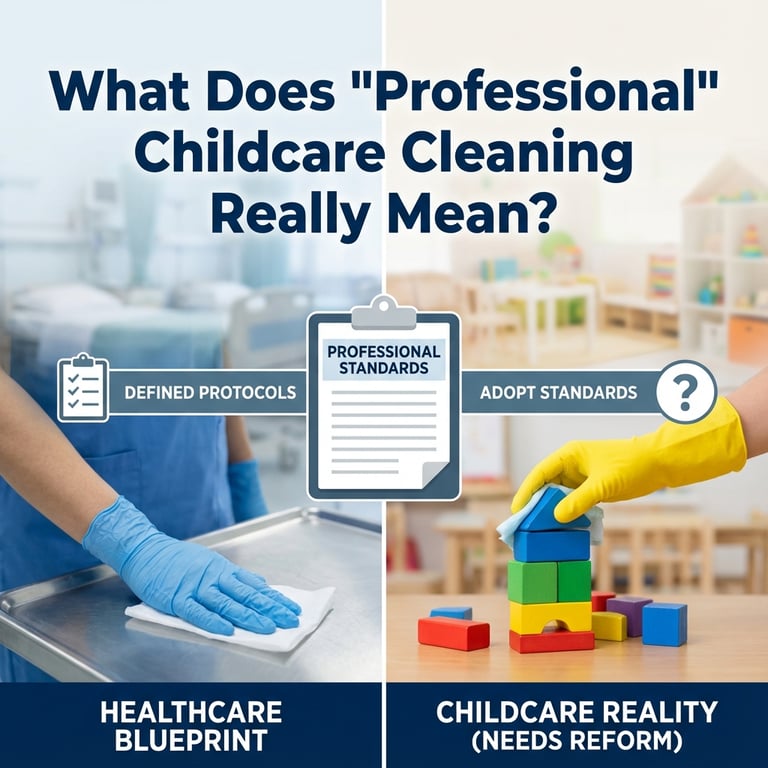
When defining what professional childcare cleaning should look like, centres don’t need to start from scratch. The healthcare sector has already created a blueprint for infection‑control cleaning — and childcare centres face similar high‑risk challenges.
Hospitals and aged‑care facilities operate under defined requirements:
Clear infection‑control protocols for high‑touch surfaces and shared equipment.
Use of approved disinfectants with proven effectiveness against pathogens.
Compliance reporting and documentation for audit purposes.
Integration of cleaning staff as part of the infection‑control team.
Childcare centres may not treat patients, but they do care for highly vulnerable groups — young children, educators, and families — in environments where illness spreads rapidly. The same principles apply: defined standards, accountability, and collaboration.
Healthcare vs Childcare Cleaning Standards
Healthcare already has a defined blueprint for infection‑control cleaning. Childcare doesn’t need to reinvent the wheel — it needs to adopt, define, and enforce similar standards with its contractors.
✅ Healthcare: Defined infection‑control protocols for high‑touch surfaces and shared equipment
❌ Childcare: Centres need to define infection‑control protocols for toys, play equipment, bathrooms, and high‑touch areas✅ Healthcare: Use of approved disinfectants with proven effectiveness against pathogens
❌ Childcare: Centres must specify approved, childcare‑safe disinfectants and verify contractors are using them✅ Healthcare: Compliance reporting and audit documentation
❌ Childcare: Centres should demand compliance reporting and keep documentation for audits✅ Healthcare: Cleaning staff integrated into infection‑control teams
❌ Childcare: Contractors should be treated as the cleaning crew — an extension of the centre team✅ Healthcare: Accountability for maintaining cleaning standards
❌ Childcare: Centres must set accountability measures (supply checks, restock requests, performance monitoring)✅ Healthcare: Regular monitoring and performance checks
❌ Childcare: Centres should establish monitoring systems (spot checks, feedback loops, audits)
Why Reform Is Needed
If centres want to improve staff retention, a shift in thinking is required. Too often, contract cleaners:
Provide only a basic clean.
Leave without reporting or collaborating with staff.
Offer little to no compliance documentation.
This approach is not enough for childcare centres, which are high‑risk environments. The health of workers, children, and families depends on cleaners using the correct methods for infection control — just as healthcare facilities demand.
External Evidence
Healthcare cleaning standards are well‑documented:
The Australian Commission on Safety and Quality in Health Care requires environmental cleaning as part of infection prevention under the National Safety and Quality Health Service Standards.
Queensland Health outlines that cleaning and disinfection must be routine, risk‑assessed, and documented to control multi‑resistant organisms.
The Aged Care Quality and Safety Commission provides detailed cleaning resources, including audits and compliance tools.
Childcare guidance exists but is less defined:
The NHMRC Staying Healthy guidelines (6th edition, 2024) emphasise infection‑control practices in early childhood services but stop short of contractor‑level standards.
ACECQA’s Infectious Diseases Policy Guidelines require centres to have policies for managing illness, but cleaning contractors are rarely specified.
This gap highlights the need for childcare centres to adopt the healthcare blueprint and demand professional, accountable cleaning.
Key Takeaway
Childcare is not an office. It is a high‑risk environment, and the health of staff and children depends on infection‑control cleaning that mirrors healthcare standards. Professional cleaning must be defined, documented, and demanded by centres themselves.
BLB Childcare Cleaning service as created a cleaning management work book. That can be purchased and used by any centre
Sources: Australian Commission on Safety and Quality in Health Care; Queensland Health; Aged Care Quality and Safety Commission; NHMRC Staying Healthy Guidelines; ACECQA Infectious Diseases Policy.
Contact
Lindsay Smith
BLB Penrith's trusted childcare cleaning Partner
info@blbcleaningservices.net
Phone
0432 355 396
© 2025. All rights reserved.